PP Food Trays: Durable, Heat-Resistant, and Sustainable Packaging Solutions by Xiamen Dashan

Quick Summary
PP food trays have become a staple in food packaging due to their remarkable durability, heat resistance, and chemical stability. Serving industries from restaurants and fast food chains to airline catering and meal delivery, PP trays are revolutionizing the way food is stored, transported, and served. Xiamen Dashan, a global leader in high-quality food packaging solutions, provides a wide range of PP trays designed to meet the diverse needs of the modern food industry. This article explores the advantages, applications, sustainability benefits, and practical considerations of PP food trays.
Introduction
Polypropylene (PP) is a thermoplastic polymer widely recognized for its strength, versatility, and resistance to heat and chemicals. In the food packaging industry, these properties make PP an ideal material for trays used for hot meals, ready-to-eat salads, and frozen foods. Xiamen Dashan, established as a trusted manufacturer of premium food packaging, produces an extensive range of PP trays, lunch boxes, and multi-compartment containers with global certifications, customizable designs, and innovative material solutions.
As the global food packaging market grows, with an estimated CAGR of 5.8% from 2023 to 2030 (Grand View Research, 2023), understanding the advantages of PP trays becomes crucial for businesses seeking safe, sustainable, and efficient packaging solutions.

1. Material Benefits of PP Food Trays
1.1 Durability and Strength
PP trays are known for their high impact resistance, ensuring food is transported without damage. Unlike polystyrene (PS) or thin polyethylene (PE) trays, PP maintains its integrity under pressure, reducing spillage and food waste.
Data Table: Comparative Impact Resistance of Food Packaging Materials
| Material | Impact Resistance (J/m²) | Notes |
|---|---|---|
| PP | 150–200 | High strength, ideal for heavy foods |
| PS | 50–70 | Brittle, prone to cracking |
| PET | 120–160 | Good, but less flexible than PP |
| PE | 90–110 | Lower rigidity, soft material |
Source: Plastics Technology
1.2 Heat Resistance
PP trays can withstand temperatures from -20°C to 120°C, making them suitable for hot meals, microwaving, and chilled foods. Unlike PLA or PET trays, PP does not deform easily at high temperatures, offering safety and convenience for both food providers and consumers.
1.3 Chemical Resistance
PP is resistant to oils, acids, and many chemicals commonly present in sauces, dressings, or condiments. This property prevents leakage, contamination, and flavor alteration, ensuring the food maintains its quality and taste.

2. Applications of PP Food Trays
PP trays are versatile and adaptable across multiple sectors:
Restaurant & Takeout: Ideal for hot meals, stir-fried dishes, and fast food combos.
Meal Delivery & Catering: Multi-compartment PP trays separate dishes to prevent mixing of flavors.
Frozen Foods: Resistant to freezer temperatures, PP trays maintain food shape and texture.
Airline Catering: Lightweight, strong, and heat-resistant trays that meet airline safety standards.
Table: PP Tray Applications and Suitability
| Application | Recommended PP Tray Type | Temperature Range | Notes |
|---|---|---|---|
| Hot meals | Single-compartment, deep trays | 0–120°C | Microwave-safe |
| Salads & cold foods | Shallow, multi-compartment trays | -5–40°C | Transparent lids for visibility |
| Frozen meals | Stackable trays | -20–100°C | Leak-resistant options available |
| Airline meals | Lightweight, compartment trays | 0–100°C | Meets IATA and food safety regulations |
Source: Dashan internal data & Food Packaging Forum
3. Sustainability and Environmental Impact
PP is recyclable (recycling code #5), making it a more sustainable option compared to PS or composite plastics. Dashan’s PP trays are designed to be fully recyclable in local facilities, contributing to reduced landfill waste.
Benefits of PP Trays for Sustainability:
Lower energy consumption in production compared to metals or glass trays.
Longer shelf-life reduces food spoilage and packaging waste.
Compatibility with mechanical recycling systems, enabling circular economy models.
Table: PP vs Other Plastic Materials – Environmental Profile
| Material | Recyclable | Energy for Production (MJ/kg) | Degradation Time | Notes |
|---|---|---|---|---|
| PP | Yes (#5) | 85 | 20–30 years | Can be reprocessed |
| PS | Partial | 100 | 50–80 years | Often not recycled |
| PET | Yes (#1) | 95 | 20–25 years | Commonly recycled |
| PLA | Compostable | 60 | 6–12 months | Industrial composting only |
Source: European Bioplastics

4. Xiamen Dashan’s PP Tray Solutions
Xiamen Dashan offers a complete range of PP trays, including:
Single-compartment trays for hot meals and stir-fries
Multi-compartment trays for balanced meal presentation
Microwave-safe trays for meal delivery services
Stackable trays optimized for space and logistics efficiency
Key Advantages of Dashan PP Trays:
Customizable Sizes and Compartments – adaptable to menu needs.
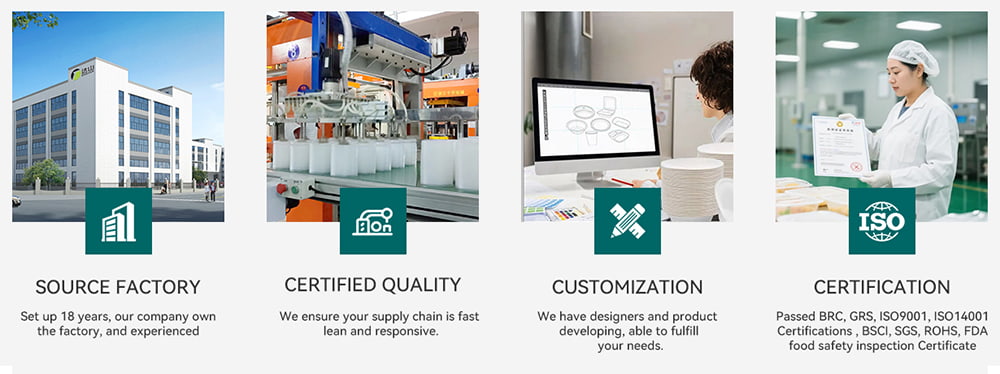
Global Certifications – including FDA, LFGB, and BRCGS compliance.
Durability – strong enough for long-distance transport without deformation.
Sustainable Design – recyclable material and optimized production processes.
5. Comparative Analysis with Other Materials
Table: PP vs PET vs PLA in Food Trays
| Feature | PP | PET | PLA |
|---|---|---|---|
| Heat Resistance | High (up to 120°C) | Medium (up to 70°C) | Low (up to 50°C) |
| Cold Resistance | Very Good | Very Good | Moderate |
| Chemical Resistance | Excellent | Good | Poor |
| Durability | Excellent | Good | Moderate |
| Recyclable | Yes (#5) | Yes (#1) | Compostable |
| Microwave Safe | Yes | Limited | No |
| Transparency | Moderate | High | Moderate |
Source: Dashan internal testing & Plastics Insights
6. Cost and Efficiency Considerations
PP trays are cost-effective due to:
Lightweight design reducing transport costs.
Stackable configurations saving warehouse space.
Durability preventing breakage and loss during transport.
Table: Example Logistics Savings Using PP Trays (per 1000 trays)
| Tray Type | Weight per Tray | Shipping Cost | Space Efficiency | Notes |
|---|---|---|---|---|
| PP Single-compartment | 50g | $120 | High | Lightweight |
| PET Single-compartment | 70g | $170 | Medium | Heavier |
| PS Single-compartment | 60g | $150 | Low | Brittle |
7. Frequently Asked Questions (FAQ)
Q1: Are PP trays microwave safe?
A1: Yes, most Dashan PP trays can safely withstand microwaving up to 120°C.
Q2: Can PP trays be used for frozen meals?
A2: Absolutely. They maintain structure and integrity down to -20°C.
Q3: Are PP trays recyclable?
A3: Yes, PP trays are labeled with recycling code #5 and can be reprocessed.
Q4: Do PP trays leach chemicals into food?
A4: No, Dashan PP trays meet FDA and LFGB standards for food safety.
Q5: Can PP trays hold acidic or oily foods?
A5: Yes, they are highly resistant to acids, oils, and fats, making them ideal for sauces and dressings.
Q6: Are PP trays environmentally friendly?
A6: Yes, they are recyclable, energy-efficient to produce, and reduce food wastage due to durability.
Q7: Can PP trays be customized?
A7: Yes, Dashan offers custom sizes, compartments, and lid options to fit specific food packaging needs.
8. Case Studies
Case Study 1: Airline Catering
Dashan PP trays were adopted by a leading airline catering company for in-flight meals. Benefits included:
Reduced breakage by 35%
Improved meal temperature retention
Compliance with airline food safety standards
Case Study 2: Meal Delivery Services
A meal delivery startup switched from PS to PP trays for hot meals and salads, resulting in:
20% cost reduction in shipping
Increased customer satisfaction due to leak-free meals
Easier recycling and reduced environmental footprint

9. Global Market Insights
The global PP food tray market is projected to reach USD 3.4 billion by 2030, driven by:
Rising demand for takeout and delivery services
Growth in ready-to-eat meals
Preference for microwave-safe, durable packaging
Chart: Global PP Food Packaging Market Size (2023–2030)
| Year | Market Size (USD Billion) |
|---|---|
| 2023 | 2.1 |
| 2024 | 2.3 |
| 2025 | 2.5 |
| 2026 | 2.7 |
| 2027 | 2.9 |
| 2028 | 3.1 |
| 2029 | 3.3 |
| 2030 | 3.4 |
Source: Grand View Research
10. Summary
PP food trays offer a perfect balance of durability, heat resistance, and chemical stability, making them ideal for diverse food packaging needs. Xiamen Dashan provides customizable, certified, and environmentally responsible PP trays that meet the evolving demands of the global food industry. Businesses leveraging PP trays can reduce packaging costs, improve food safety, and contribute to sustainability goals.
References
Grand View Research. Food Packaging Market Analysis.
Plastics Technology. Impact Resistance of Thermoplastics.
Food Packaging Forum. Food Contact Materials.
European Bioplastics. Environmental Profile of Plastics.
Plastics Insight. PP vs PET vs PLA Properties.
Copyright Statement
© 2026 Dashan Packing. All rights reserved.
This article is an original work created by the Dashan Packing editorial team.
All text, data, and images are the result of our independent research, industry experience,
and product development insights. Reproduction or redistribution of any part of this content
without written permission is strictly prohibited.
Dashan Packing is committed to providing accurate, evidence-based information and
to upholding transparency, originality, and compliance with global intellectual property standards.


评论
发表评论