PET Cups vs PLA Cups: Which Is Better for Cold Drinks

Quick Answer: The Ultimate Verdict
When deciding between PET Cups vs PLA Cups for cold beverages, the choice comes down to your budget, supply chain, and local environmental regulations. PET (Polyethylene Terephthalate) wins on ultimate crystal clarity, crack resistance, lower cost, and global recyclability. PLA (Polylactic Acid) wins on eco-friendliness, as it is made from renewable plant starches and is industrially compostable. However, PLA is highly sensitive to heat and will warp at temperatures above 40°C (104°F), requiring strict cold-chain logistics.
 Need customized beverage packaging? [Explore Dashan’s wholesale PET cold cups].
1. Understanding the Materials: Origins and End-of-Life
To make an informed procurement decision, importers must first understand where these materials come from and where they go after the consumer throws them away.
What is PET (Polyethylene Terephthalate)?
PET is the most widely used clear plastic in the world, commonly used for water bottles and premium cold cups.
Origin: Derived from petroleum-based raw materials.
The RPET Advantage: Today, PET does not have to mean “virgin plastic.” Many premium manufacturers now offer RPET (Recycled PET), which utilizes post-consumer recycled content, drastically reducing the carbon footprint and complying with strict new packaging taxes in Europe and the UK.
End-of-Life: 100% infinitely recyclable. It is the most successfully recycled plastic globally (Resin Identification Code #1).
What is PLA (Polylactic Acid)?
PLA is a bioplastic, meaning it is derived from biological resources rather than fossil fuels.
Origin: Made by fermenting plant sugars, most commonly from corn starch, cassava, or sugarcane.
End-of-Life: It is [Industrially Compostable]. It will not degrade in a marine environment or a backyard compost bin. It must be sent to a commercial facility with sustained high temperatures to break down into biomass.
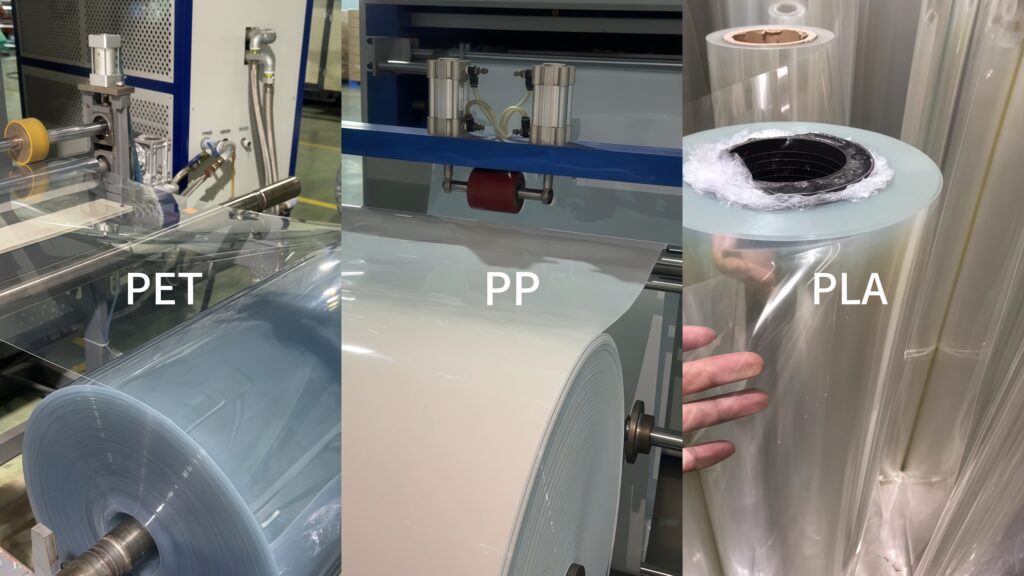
2. The Ultimate Comparison Table: PET vs. PLA
For procurement managers, the decision often comes down to the raw numbers. Here is how the two materials stack up against each other in real-world commercial applications:
| Feature / Metric | PET (Polyethylene Terephthalate) | PLA (Polylactic Acid) Bioplastic |
| Raw Material Source | Fossil fuels or Post-Consumer Recycled (RPET) | Renewable plant resources (Corn/Sugarcane) |
| Visual Clarity |  (Glass-like transparency) (Glass-like transparency) | (Very clear, slight yellowish/milky tint in thick sections) |
| Durability & Flexibility | Excellent. High crack resistance; won’t shatter when squeezed. | Good, but more brittle. Can crack under heavy pressure. |
| Heat Tolerance (Crucial) | Up to 70°C (158°F) before softening. | Max 40°C (104°F). It will melt/warp above this. |
| Cold Tolerance | Excellent. Freezer safe down to -20°C. | Excellent. Perfect for iced drinks and smoothies. |
| Average Shelf Life | 5+ Years (Highly stable) | 12 to 18 Months (Will become brittle over time) |
| Wholesale Cost | $ (Most cost-effective) | $$$ (Usually 30% – 50% more expensive than PET) |
3. The Importer’s Nightmare: The PLA Shipping Warning
 CRITICAL WARNING FOR BUYERS: If you are importing PLA cups from China, you must account for international shipping temperatures.
Because PLA begins to warp and deform at just 40°C (104°F), standard shipping containers are highly dangerous. A standard steel shipping container crossing the equator or sitting in a port in the Middle East, Southern USA, or Australia during summer can easily reach internal temperatures of 60°C to 70°C (140°F – 158°F).
If you ship PLA in a standard dry container during the summer, your entire shipment will arrive melted into a solid block of unusable plastic.
The Solution: Importers buying bulk PLA must pay extra for a Reefer (Refrigerated) Container to maintain a stable temperature during sea freight. This significantly increases your landed cost per unit.
The PET Advantage: PET cups are completely stable in hot shipping containers, eliminating this logistical headache and keeping freight costs low.
4. Performance in the Real World: Why Delivery Drivers Prefer PET
Beyond logistics, how do these cups perform in a busy coffee shop or bubble tea store?
The Lid Seal: PET is highly flexible. When a barista snaps a lid onto a PET cup, the rolled rim of the cup flexes slightly, creating an incredibly tight, leak-proof seal. This is vital for food delivery apps (UberEats, DoorDash) where spills lead to refunds. PLA is more rigid and brittle; snapping a lid on too aggressively can sometimes crack the rim of the cup.
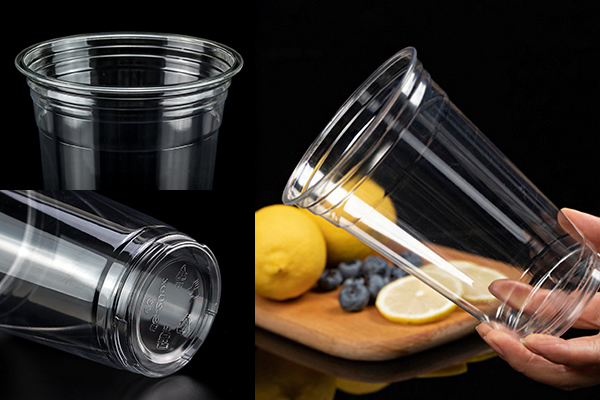
Visual Merchandising: For brands selling colorful beverages like matcha lattes, layered smoothies, or fruit teas, presentation is everything. PET offers unparalleled, glass-like clarity that makes the colors pop.
Curious why major brands refuse to switch away from PET? Read our deep dive: [Why PET Cups Dominate Cold Beverage Packaging].
5. Best Use Cases: Which Should You Buy?
There is no “wrong” material, only the wrong material for your specific market.
You Should Buy PET (or RPET) Cups If:
You want the best ROI: You are operating a high-volume business (like a stadium, festival, or massive franchise) where unit cost and freight efficiency are the top priorities.
You are in a hot climate: You don’t want to risk inventory melting in your non-air-conditioned warehouse.
You need heavy custom branding: PET has a remarkably smooth surface that holds ink beautifully for 6-color custom logos.
Planning a branding upgrade? See our [Ultimate Guide to Custom Printed PET Cups: MOQs and Lead Times].
You Should Buy PLA Cups If:
You operate in strict “Plastic-Ban” zones: Cities or countries that have completely outlawed petroleum-based single-use plastics.
You have a premium, eco-conscious brand: Organic cafes, vegan restaurants, and eco-resorts where customers are willing to pay a premium for sustainability.
You have access to commercial composting: Your local municipality actually collects and commercially composts bioplastics (without this, PLA just ends up in a landfill).

6. Conclusion: Navigating the Beverage Packaging Maze
Choosing between PET and PLA isn’t just a matter of price; it’s a strategic decision that impacts your logistics, brand image, and environmental compliance.
If your market demands sustainability but you cannot handle the logistical fragility of PLA, we highly recommend exploring RPET (Recycled PET) as the perfect middle ground—offering the durability and low freight costs of traditional plastic with a verified, circular-economy eco-footprint.
At Dashan Packing, we manufacture millions of cold beverage cups monthly. Whether you need the unmatched clarity of our [custom printed beverage packaging] or are exploring bioplastic alternatives, our expert export team can help you calculate freight costs, verify local compliance, and choose the perfect material for your brand.
[Contact Dashan Today for a Free Material Consultation and Pricing]
FAQ: PET vs PLA Cold Cups
1. Can I put hot coffee in a PET or PLA cup?
No. Both PET and PLA are strictly for cold or room-temperature beverages. Pouring hot liquid into either cup will cause it to melt and collapse instantly. For hot drinks, you must use PP (Polypropylene) cups or lined paper cups.
2. Are PET cups BPA-free and food-safe?
Yes. All high-quality PET cups manufactured by reputable suppliers (like Dashan Packing) are 100% BPA-free, non-toxic, and fully compliant with FDA and EU food contact regulations.
3. Will PLA cups dissolve in my customer’s drink?
No. While PLA is compostable, it only breaks down under extreme industrial heat and microbial action. It functions exactly like normal plastic while holding a cold iced coffee or smoothie and will not dissolve or get soggy.
4. How can consumers tell the difference between PET and PLA?
Visually, they look almost identical. However, look at the bottom of the cup. PET will have a recycling triangle with the number “1”. PLA will typically have a recycling triangle with the number “7” (Other) and should be clearly printed with “PLA” or “Compostable”.
5. Is PLA cheaper than PET?
No. Because the agricultural harvesting, fermentation, and polymerization process of creating bioplastic is complex, PLA cups are generally significantly more expensive than standard PET cups.
References & Authoritative Industry Data
To ensure our clients make procurement decisions based on scientific fact rather than marketing claims, Dashan Packing bases its material analysis on data from the following global authorities:
The Association of Plastic Recyclers (APR): The APR Design® Guide for Plastics Recyclability (The industry-leading standard detailing the recyclability of PET and the environmental benefits of transitioning to Post-Consumer Recycled PET / RPET).
National Association for PET Container Resources (NAPCOR): PET Recycling Reports and LCA Data (Authoritative data confirming PET’s status as the most highly recycled plastic globally and its lower energy requirements during the recycling process).
European Bioplastics: Factsheet: Bioplastics and the Circular Economy (The definitive scientific consensus detailing why PLA requires industrial composting facilities with sustained temperatures above 55°C (131°F) to properly degrade).
Environmental Protection Agency (US EPA): Advancing Sustainable Materials Management (Official United States guidelines on the end-of-life management, recycling infrastructure realities, and greenhouse gas implications of various packaging materials).
(Note: Material life-cycle data and municipal recycling capabilities vary significantly by country and region. The information provided in this comparison guide is for strategic sourcing and educational purposes. We advise importers to evaluate their local waste management infrastructure when choosing between recyclable and compostable packaging formats.)
Copyright & Legal Disclaimer
© 2026 Dashan Packing. All rights reserved.
This Material Comparison Guide (PET vs. PLA) is an original work created by the Dashan Packing technical and export teams. All material performance metrics, shipping warnings, and environmental assessments are the result of our independent manufacturing experience and industry research. Reproduction, redistribution, or unauthorized use of any part of this content without explicit written permission from Dashan Packing is strictly prohibited. Dashan Packing is committed to providing transparent, evidence-based data to assist global food service brands in optimizing their packaging supply chains.


评论
发表评论