PLA vs PET Cups: A Complete Comparison for Eco-Conscious Brands

Quick Answer: The Procurement Bottom Line
PLA vs PET Cups For cold beverages, [PET cups] offer the best return on investment (ROI), unbeatable durability, and flawless clarity at a lower cost. [PLA cups] demand a higher eco-premium and are strictly limited to cold drinks, but they offer immense marketing value for sustainable brands. The verdict: If brand image and environmental storytelling are your top priorities, choose PLA. If unit cost, operational stability, and high-volume consistency are your priorities, choose PET.
1. Why This Matters: The “Walking Billboard” Dilemma
If you run a specialty coffee roastery, a franchised boba tea network, or an artisan juice bar, you already know the truth: Your cup is not just a container; it is a walking billboard. When a customer walks down the street carrying your iced matcha latte, that cup is the most visible marketing asset your brand possesses. Today’s beverage directors and cafe founders face a massive dilemma. You must balance three conflicting forces:
Aesthetic Appeal: The cup must be crystal clear to show off the layered colors of a nitro cold brew or fruit tea, and it must hold [custom printing] flawlessly.
Consumer “Political Correctness”: Gen Z and Millennial consumers are fiercely loyal to brands that align with their environmental values. Serving a premium $8 iced coffee in a standard, unbranded plastic cup can instantly degrade your brand’s perceived value.
The CFO’s Reality: Packaging costs directly eat into the profit margin of every single drink sold. You must control overhead without looking cheap.
Choosing between PLA (Polylactic Acid) and PET (Polyethylene Terephthalate) is the ultimate test of balancing your brand’s marketing narrative with your operational budget.

2. The Fatal Flaw of PLA: A Storage & Logistics Nightmare
Before you commit to a 100,000-cup order of eco-friendly PLA, you must understand its fatal flaw. PLA is a bioplastic derived from renewable resources like fermented corn starch or sugarcane. Because it is designed to break down, it is fundamentally unstable under heat.
The 40°C (104°F) Danger Zone:
PLA has an incredibly low heat distortion temperature. If a PLA cup is exposed to temperatures exceeding 40°C, it will begin to warp, melt, and fuse together.
For a cafe owner or procurement manager, this creates severe logistical strictures:
Warehouse Conditions: You cannot store PLA cups in an un-airconditioned warehouse during the summer. If your storage facility gets hot, your entire inventory will melt into unusable blocks of bioplastic.
Shipping Risks: You cannot ship PLA via standard sea freight during peak summer months unless you pay a massive premium for a “Reefer” (Refrigerated) shipping container.
In-Store Operations: Baristas cannot leave sleeves of PLA cups sitting next to a hot espresso machine or in a sunlit window display.
If your supply chain lacks strict temperature control, then PLA will become a massive financial liability. PET, on the other hand, is highly stable and can withstand standard warehouse heat and global shipping conditions without issue.
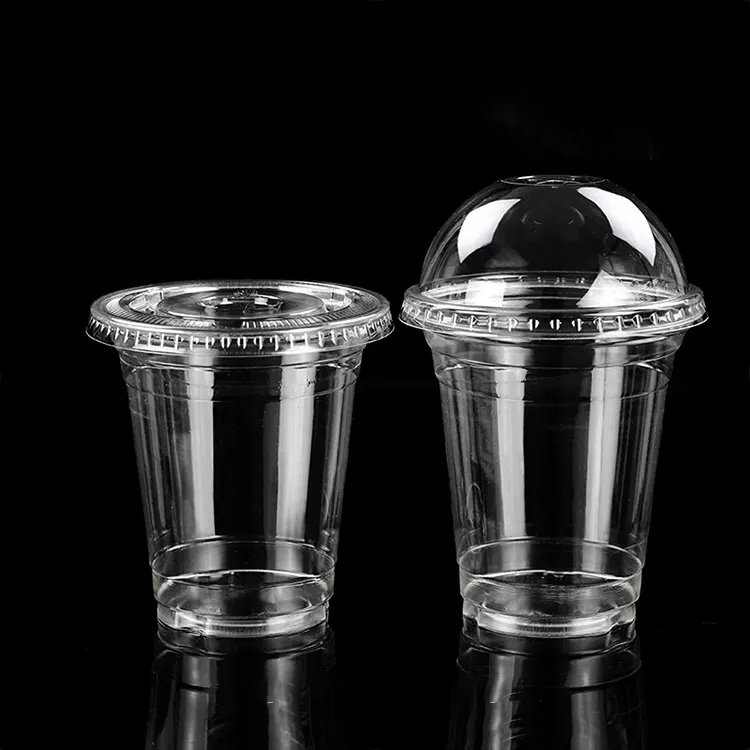
3. Material Deep Dive: Thermoformed Precision
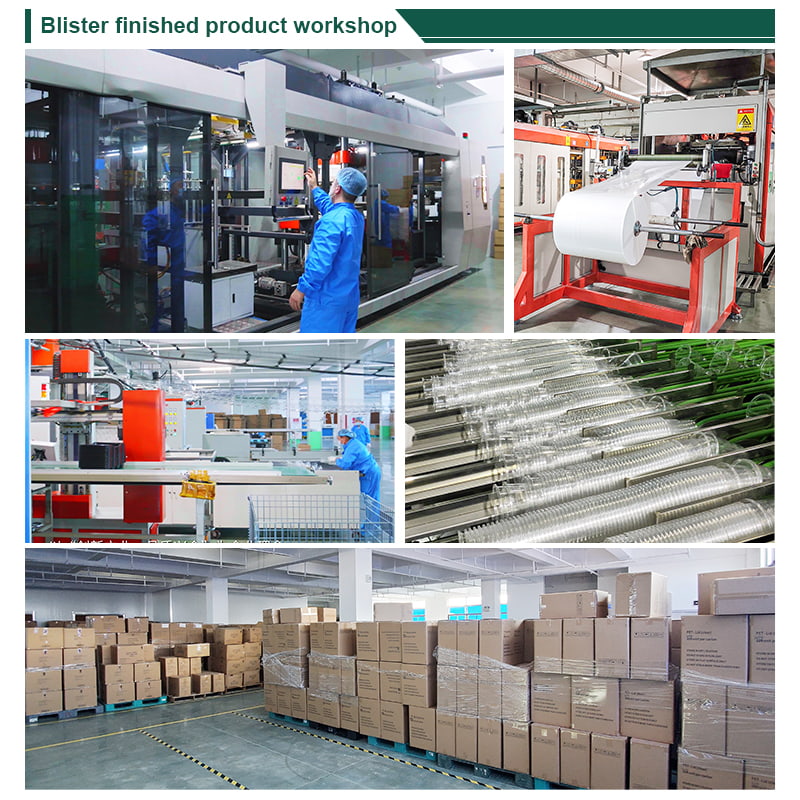
Regardless of whether you choose PET or PLA, the manufacturing process dictates the quality of the final product. At Dashan, our clear cups are not made using cheap injection-molded methods; they are manufactured using advanced [thermoforming] lines.
Thermoforming ensures that the lip of the cup is perfectly rolled and the dimensions are accurate to the micro-millimeter. This is critical for boba shops and cafes: when a barista snaps a lid onto a thermoformed cup, it creates a tight, leak-proof mechanical seal that survives aggressive shaking and delivery drivers.
Here is how the two thermoformed materials compare:
| Feature | PET (Polyethylene Terephthalate) | PLA (Polylactic Acid / Bioplastic) |
| Source Material | Petroleum-based (Highly recyclable). | Plant-based (Corn starch / Sugarcane). |
| Clarity / Transparency |  (Glass-like perfection). (Glass-like perfection). | (Excellent clarity). |
| Heat Resistance | Up to 70°C (158°F). Stable in storage. | Max 40°C (104°F). Melts easily. |
| Environmental Claim | 100% Recyclable (If infrastructure exists). | 100% Commercially Compostable. |
| Unit Cost | Low. The industry standard. | High. Usually 30% to 50% more expensive. |
4. Branding & Printing: Telling the Green Story
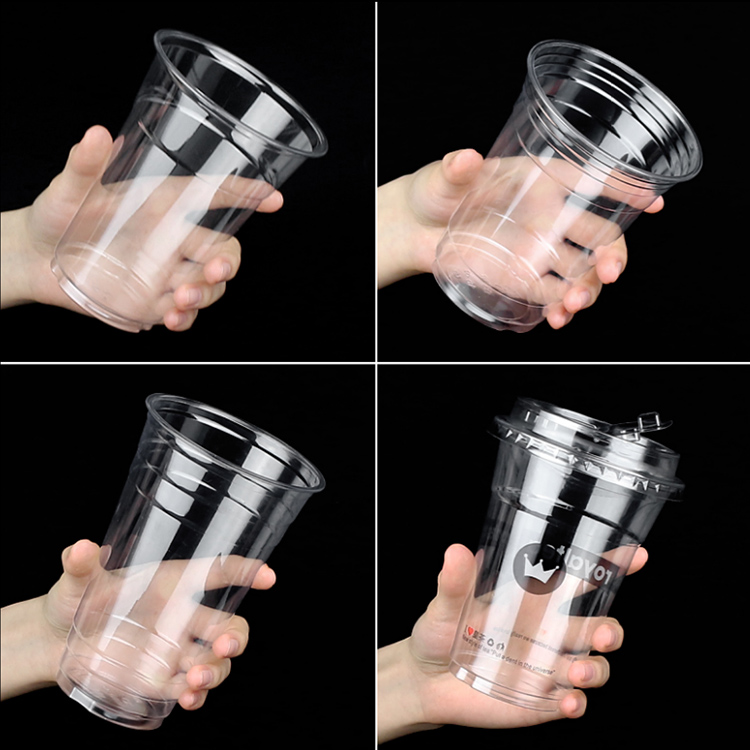
A blank cup is a missed opportunity. Custom printing is what transforms a generic beverage into a viral, Instagram-worthy brand moment.
Both PET and PLA offer excellent surfaces for [custom printed cups]. Our specialized food-safe ink adheres perfectly to both thermoformed materials, allowing for vibrant up to 6-color wraparound prints.
However, the marketing value of the print differs significantly:
Printing on PET: Delivers a sharp, premium look. It tells the customer you are a professional, established brand.
Printing on PLA: Delivers a powerful brand narrative. When you custom print your logo on a PLA cup, you can also print “100% Compostable” or “Made from Plants” right next to it. This allows you to tell a compelling “Green Brand Story.” Customers paying a premium for organic, fair-trade coffee or artisanal boba expect the packaging to match the ethos of the ingredients. PLA justifies the premium price tag of your menu.
5. Procurement Advice: The “If-Then” Math
So, which cup should your purchasing department order? Do not guess; run the math on your specific business model.
When to Choose PET (The Operational Winner):
If your average drink price is below $5.00.
If you run a high-volume, fast-paced franchise where margins are tight and volume is everything.
If you do not have temperature-controlled warehouses to store bulk inventory.
Decision: Stick to high-quality [PET cups]. They offer the premium look your brand needs without the operational risks or high costs of bioplastics.
When to Choose PLA (The Premium Brand Builder):
If your average drink price is $6.00 to $9.00 (e.g., specialty third-wave coffee, organic cold-pressed juices).
If your brand identity is built heavily on sustainability, organic ingredients, or eco-conscious living.
If you can confidently pass the $0.05 – $0.10 extra packaging cost onto the consumer as an “eco-premium.”
Decision: Invest in [PLA cups]. The slight increase in packaging cost will be heavily outweighed by the intense brand loyalty and social media marketing you generate from eco-conscious demographics.
6. Conclusion: Bring Your Brand to Life
Selecting the right cup is only half the battle; the visual execution is what drives sales. Whether you choose the reliable, cost-effective clarity of thermoformed PET or the premium, sustainable storytelling of PLA, your brand deserves packaging that looks spectacular.
Do not let your beverage leave the store in a blank cup. At Dashan Packing, we specialize in transforming standard packaging into high-conversion brand assets for global franchises.
Ready to see exactly what your brand would look like on our premium cups?
 [Submit your Logo to Dashan today for a FREE Digital Mockup]. Let our design and engineering team show you how we can elevate your brand presentation and lower your supply chain costs.
FAQ: PLA & PET Beverage Cups
1. Can PLA cups be composted in a home backyard compost bin?
No. PLA is “commercially compostable,” not home compostable. It requires the high heat (consistently above 60°C/140°F), humidity, and specific microbes found only in industrial composting facilities to break down completely within 90 to 120 days. In a typical backyard bin, a PLA cup can take years to degrade.
2. Does custom printing on a PLA cup ruin its compostability?
Not if you use the right manufacturer. At Dashan Packing, we use specific, certified food-grade and eco-friendly inks for our PLA printing. These inks comply with compostability standards, ensuring that the custom branding does not introduce toxic heavy metals into the compost soil.
3. How long can I store bulk PLA cups in my cafe’s stockroom?
The standard shelf life for PLA packaging is 6 to 12 months. However, this is highly dependent on storage conditions. They must be kept in a cool, dry environment, strictly below 40°C (104°F), and away from direct sunlight to prevent premature warping or degradation.
4. Are PET cups actually recycled into new cups?
PET (Resin ID #1) is the most widely and easily recycled plastic in the world. When properly disposed of in municipal recycling streams, clear PET cups are frequently washed, melted, and repurposed into RPET (Recycled PET) for new food packaging, textiles, or consumer goods, creating a closed-loop system.
5. Which cup material is better for a tight, leak-proof lid seal?
Both materials can achieve an excellent seal if they are manufactured correctly. Because our PET and PLA cups are both produced using highly precise thermoforming technology rather than cheaper injection molding, they feature incredibly uniform rolled rims. This ensures a flawless, leak-proof “snap-fit” with their respective lids.
References & Authoritative Industry Standards
To help specialty beverage brands make informed, data-driven packaging decisions, Dashan Packing bases its material assessments and sustainability claims on research from the following global authorities:
ASTM International: ASTM D6400 Standard Specification (The definitive North American standard detailing the exact testing parameters and industrial conditions required for solid materials, like PLA bioplastics, to be legally labeled as “commercially compostable”).
Ellen MacArthur Foundation: The New Plastics Economy (Authoritative global reports on circular economy strategies, highlighting the critical role of highly recyclable materials like PET in reducing virgin fossil fuel reliance).
U.S. Food and Drug Administration (FDA): Inventory of Effective Food Contact Substance (FCS) (The regulatory framework confirming the absolute safety, chemical stability, and non-toxicity of both virgin PET and food-grade PLA for direct cold beverage contact).
Specialty Coffee Association (SCA): Sustainability in Coffee Packaging (Industry research emphasizing the importance of aligning café packaging choices with the environmental expectations of modern, premium coffee consumers).
Copyright & Legal Disclaimer
© 2026 Dashan Packing. All rights reserved.
This Material Comparison Guide is an original work created by the Dashan Packing technical and export teams. All material performance limits (including PLA thermal tolerances), manufacturing insights (such as thermoforming precision), and sustainability assessments are the result of our independent industry research and B2B packaging experience. Reproduction, redistribution, or unauthorized use of any part of this content without explicit written permission from Dashan Packing is strictly prohibited. Dashan Packing provides this information for educational and strategic procurement purposes to assist global beverage brands.


评论
发表评论